Welcome All Wenatchee Valley Visitors
Well hello! Welcome to the Apple Capital of the World. We are located in the center of Washington state, nestled between the Cascade mountains and the Columbia river. The Wenatchee Valley is comprised of bustling communities on both sides of the river. The sister cities of Wenatchee and East Wenatchee are two cities and two counties divided by the mighty Columbia river but united as one community, while the town of Cashmere, just 10 miles west, offers visitors a taste of vintage ‘small town America’.
What to Expect When you Arrive in the Valley
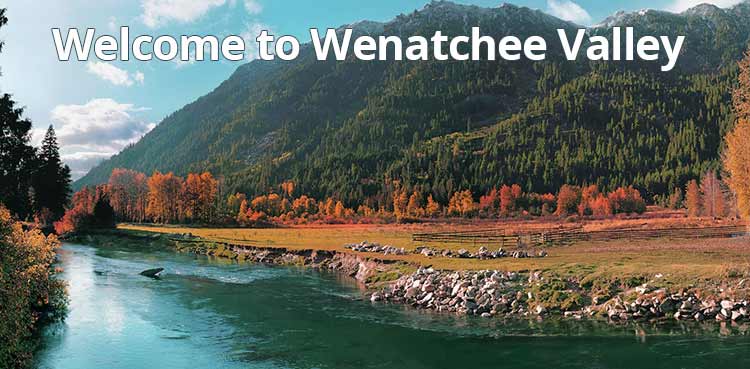
As you arrive in the Valley, you’ll pass miles and miles of lush green orchards – apple, pear and cherry – cut by cascading rivers snaking through semi-arid flat lands and canyons. In spring, the craggy mountainsides are carpeted in yellow, as the local wildflower, balsamroot, blooms in unison.
As you enter the city of Wenatchee, the snow topped Cascade Mountains rise to the west and the mighty Columbia river glitters to the east. Tree-lined streets lead to the hub and life of our community – the award-winning historic downtown.
A Little About East Wenatchee
Every evening, East Wenatchee visitors are treated to one of nature’s most spectacular displays, as the sun sets over the Cascade Mountains, radiating pink, orange and purple streams across the horizon. To the east, the moon rises over Badger Mountain and a blanket of stars appear in the clear evening sky.
With Pangborn Memorial Airport, the Wenatchee Valley Mall and 300 acres of riverside parks bordering the Columbia river, you can spend an adventurous day exploring this city on the east side of the Valley.
If adventurous ‘firsts’ interest you, East Wenatchee has a ‘first’ of its own. On October 5, 1931, Clyde Pangborn and Hugh Herndon Jr. landed in East Wenatchee after completing the first non-stop trans-Pacific airplane flight originating in Misawa, Japan. You can see a replica of their famous plane, the Miss Veedol, at Ballard Park. And to this day, Misawa, Japan, remains an active sister-city with East Wenatchee, helping to create the Bridge of Friendship Japanese Garden dedicated to the historic relationship.
How About Some Good Old Valley Trivia?
- East Wenatchee is a separate city and county from Wenatchee
- ‘The Ave’ is local slang for Wenatchee Avenue
- If you hear a local talk about their ‘Rig’, they are talking about their car or truck
- A Wenatchee traffic jam is 4 cars at a traffic light
- Traffic is heavy if it takes you more than 5 minutes to get across town
- In summer, ‘going to the market’ means shopping at the farmers market 3-weeks prior to the Apple Blossom Festival, locals stake their parade-viewing territory by tying up chairs and couches along the parade route. Known as the “Chair Count,” it can reach the upper hundreds and is tallied daily in the local newspaper.
- ‘Doing the Loop’ means working out on the 11-mile paved loop trail
- Cashmere is a city, not a premium clothing fiber
- ‘The Ridge’ is local slang for Mission Ridge Ski Area
- The dry valley air makes every day a ‘good hair day’